
How to Improve Engagement in Public Sector Teams
The everyday conditions that shape engagement
Improving engagement in public sector teams is rarely about motivation alone. Most people care about their work and want to do it well. The real challenge is helping teams stay connected, coordinated and well-led when pressure is high, time is limited and change is constant.
Engagement improves when people experience clearer conversations, more consistent leadership, stronger collaboration and a practical sense that their contribution is understood. That means moving beyond one-off engagement initiatives and focusing on the everyday conditions that shape how people experience work.
For many public sector leaders and managers, the question is not whether engagement matters. It is how to make improvement consistently hold up in real work.
Talk to us about your team — We'll explore your situation and what could help in practice.
TABLE OF CONTENTS
Why engagement can be difficult to improve in public sector teams
Public sector teams often operate in complex, high-pressure environments. Leaders are balancing delivery, service quality, workforce pressures, restructures, financial constraints, digital transformation and changing expectations from the people they serve.
In this context, engagement is shaped less by slogans and more by what happens day to day. Disengagement is estimated to cost the UK economy £14 billion annually (Work Foundation, 2022), a burden the public sector feels acutely. Yet the response is often reactive: surveys, away days, wellbeing initiatives. The Chartered Management Institute found that 82% of managers in the public sector lack formal training (CMI, 2023), which means the people most responsible for shaping everyday experience are often the least equipped to do so consistently.
Even capable managers can struggle when they are under pressure. Conversations become reactive. Team meetings focus only on tasks. Collaboration becomes harder across boundaries. Change may land technically, while the people side struggles to keep up. The issue is rarely lack of care. It is consistency under pressure.
What does not usually work in isolation
Many organisations already invest in engagement. They run surveys, leadership programmes, away days, wellbeing initiatives and change communications. Each of these can play a useful role, but they rarely improve engagement sustainably when they are not connected to everyday work.
Common limitations include:
- Survey results without practical follow-through. People share feedback, but do not always see visible change in how work happens. As one public sector employee put it in Strengthify's research: "Surveys feel like lip service. Nothing changes."
- Development activity without reinforcement. Teams leave with energy and insight, but familiar habits return when pressure rises.
- Generic leadership models. Managers understand the theory, but struggle to apply it in real conversations.
- Initiatives that rely on individual effort. Progress depends on a few motivated managers rather than a shared way of working.
The limitation is not the activity itself. It is what happens, or does not happen, after it.
What improves engagement in practice
Engagement improves when people experience work differently, not just when they hear a new message about it.
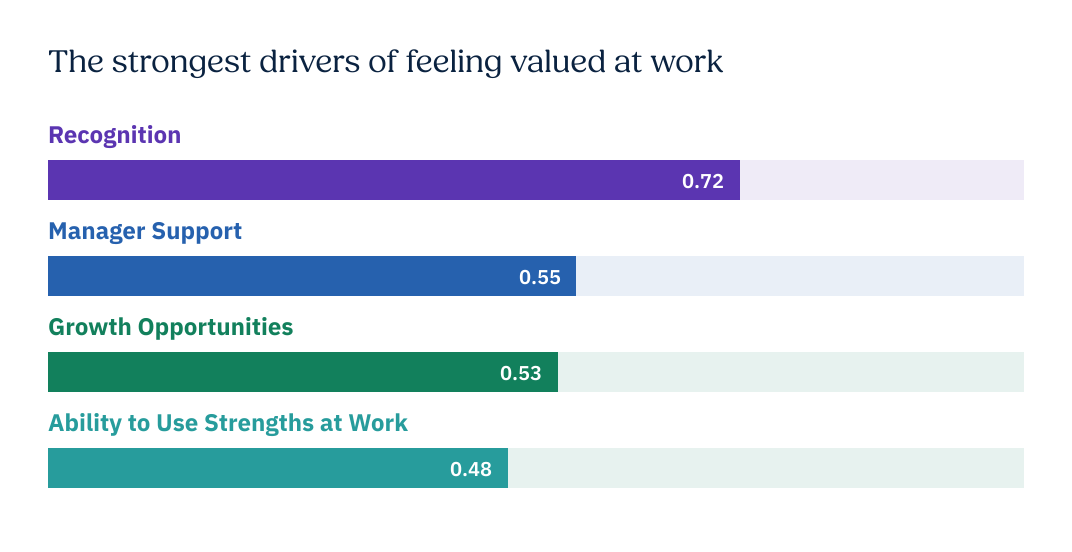
Strengthify's research across 5,750 public sector respondents found that feeling valued is the single strongest driver of engagement and the most consistent predictor of whether someone stays or leaves. Recognition alone carries a correlation of 0.72 with feeling valued, the highest of any factor measured. Manager support (0.55), growth opportunities (0.53) and the ability to use one's strengths at work (0.48) follow closely behind.
Build a shared language for how people work best
Teams often struggle because people work differently but do not have a clear language for discussing those differences. One person may process ideas quickly and out loud. Another may need time to reflect. One manager may give feedback directly. Another may avoid difficult conversations until tension has built.
Without a shared language, these differences can become personal. With one, teams can talk more constructively about how people communicate, make decisions, respond under pressure and support one another.
This is where a strengths and working styles approach can be useful. It gives people a practical way to understand how they do their best work and how that shows up in collaboration, leadership and change. The aim is not to label people. It is to make everyday working patterns easier to understand and discuss, and to give managers something concrete to work with in their conversations.
Improve the quality of everyday conversations
Engagement is shaped through conversations, not just large engagement events or annual reviews, but the regular moments where people feel heard, understood and supported. These include 1:1s, feedback discussions, team meetings, change conversations and decisions about workload and development.
When managers are under pressure, these conversations can become rushed or transactional. A 1:1 becomes a task list. Feedback becomes reactive. Change conversations become announcements rather than dialogue. Strengthify's research found that 50% of public sector employees cite poor communication as a significant source of workplace stress (IES, 2023).
Improving engagement means helping managers prepare for conversations more intentionally. Useful questions to carry into any team conversation include:
- What does this person need from this conversation?
- What strengths are they using well, and where might energy be low?
- What support or clarity would help them perform well right now?
- What needs to be discussed, not avoided?
Better conversations do not need to be longer. They need to be more deliberate.
Make leadership more consistent across teams
In many public sector organisations, engagement varies significantly from team to team. Often, this is not because strategy differs. It is because the quality of everyday leadership differs.
One team may have a manager who holds clear, supportive conversations. Another may have a manager who is technically capable but less confident with feedback or change. Strengthify's research found that only 48% of public sector employees agree their manager has the skills to maximise their potential, with 29% actively disagreeing. Gallup (2023) estimates that managers account for 70% of the variation in employee engagement scores.
This variation matters. To improve engagement across a department, directorate or service, leaders need to support managers with practical habits, not just expectations. That may include preparing for 1:1s more effectively, giving clearer feedback, recognising strengths and contribution, and leading change conversations more thoughtfully. Consistency does not mean every manager leads in the same style. It means managers have a shared approach and practical support, while still using their own judgement.
Strengthen collaboration across teams
Engagement is not only shaped by the relationship between manager and employee. It is also shaped by how well teams work together. In public sector environments, many teams depend on each other to deliver outcomes, across faculties and professional services in higher education, services and directorates in local government, and clinical, operational and support teams in health and social care.
When collaboration is strong, people experience work as more coherent and purposeful. When it is weak, frustration grows quickly. Our research found that team belonging carries a 0.41 correlation with feeling valued, and that cohesive teams are associated with a 20% lift in productivity (Engage for Success, 2021).
Common friction points include different priorities, unclear decision-making, assumptions about how others work and pressure causing teams to retreat into silos. A shared strengths and working styles language can make collaboration easier because it gives people a less personal way to discuss difference. The conversation shifts from "they are difficult to work with" to "we work differently under pressure, so how do we make that easier to navigate?"
Reinforce habits so improvement does not fade
Most development creates insight. The challenge is making that insight show up consistently in everyday work. People understand the ideas, agree with the principles, and may leave a development session feeling energised. But once they return to full diaries and operational pressure, new habits are hard to sustain.
Strengthify's research consistently shows this pattern: one-off interventions create short-term movement but do not shift engagement sustainably.
The CIPD found that strengths-based approaches, when embedded in culture rather than delivered as isolated events, lift engagement by 20% (CIPD, 2017). The difference is reinforcement, keeping strengths and working styles visible and usable in everyday conversations, team meetings, feedback discussions and decisions about work allocation.
The goal is not to add more work. It is to make useful insight easier to access at the point it is needed.
How Strengthify supports engagement in public sector teams
Strengthify helps leaders responsible for departments, directorates and services improve engagement by strengthening how leadership and teamwork show up in everyday work. Our approach brings together three connected elements.
Strengthify Profile
Understand how people work, contribute and respond under pressure.
The Strengthify Profile is a strengths and working styles framework that gives teams a shared language for how people work best, where friction can arise and how strengths show up under pressure.
Facilitated workshops and programmes
Build shared language, practical leadership habits and stronger ways of working.
Discovery Workshops, the Management Development Programme and Department and Team Sessions help managers and teams turn insight into applied practice, through better conversations, feedback, collaboration and leadership through change.
Strengthify Engage
Reinforce habits in everyday work.
Strengthify Engage is the shared digital layer that keeps strengths and working styles visible and usable in everyday conversations, decisions and team practice, so development translates into everyday behaviour rather than fading after a session.
What this can create
When engagement work is grounded in everyday leadership and teamwork, public sector organisations can build:
- clearer, more constructive conversations across teams
- more consistent leadership at every level
- stronger collaboration across departments, services or directorates
- better coordination through change and pressure
- reduced friction between teams with different ways of working
- greater confidence among managers
- a clearer sense of contribution and value for team members
Questions to ask before starting
If you are exploring how to improve engagement in your organisation, these questions can help clarify where to begin:
- Where does engagement vary most across teams?
- Which teams are under the greatest pressure or change right now?
- Are managers confident in 1:1s, feedback and change conversations?
- Do teams have a shared language for how people work best?
- Where does collaboration slow down or become tense?
- What development has already happened, and what has not stuck?
- What would better engagement look like in everyday behaviour?
These questions often reveal that engagement is not a standalone issue. It is closely connected to leadership consistency, team coordination and the quality of everyday conversations.
In summary
To improve engagement in public sector teams, focus on the everyday conditions that shape people's experience of work. Disengagement costs the UK economy £14 billion each year, yet the most common responses, surveys, one-off workshops, generic leadership training, rarely create lasting change on their own. Engagement improves when managers and teams have clearer conversations, a shared language for how people work, more consistent leadership and practical ways to collaborate through pressure and change. The real shift happens when insight becomes part of everyday work, and when managers have the practical support to make that happen consistently.
Ready to explore how this could work across your teams?
If you are responsible for a Department, Directorate or Service and want to improve engagement in a way that connects to real work, we would welcome a conversation. Talk to us about your team. We'll walk you through your situation, explore what could help in practice and show you how the Strengthify Profile, facilitated development and Strengthify Engage work together using examples from teams like yours.
Frequently Asked Questions
Public sector organisations can improve team engagement by strengthening everyday leadership, improving the quality of conversations, building shared language across teams and reinforcing new habits over time. Strengthify's research found that feeling valued is the strongest predictor of engagement and intent to stay, and that recognition, manager support and the opportunity to use one's strengths are the factors most closely linked to that feeling.
Engagement often varies because local leadership quality varies. Strengthify's research found that only 48% of public sector employees agree their manager has the skills to maximise their potential. Even within the same organisation, some teams experience clearer communication, better feedback and stronger coordination than others. Improving engagement across an organisation means reducing that variation with practical support for managers, not just expectations.
Managers play a critical role because they shape the everyday conversations that influence trust, clarity, motivation and contribution. Gallup estimates managers account for 70% of the variation in employee engagement scores. Yet 82% of managers in many public sector settings lack formal training (CMI, 2023). Engagement cannot depend only on individual goodwill or natural ability, and managers need practical support and shared approaches to lead consistently.
Engagement initiatives often fail to stick because they are not embedded in everyday work. Surveys, workshops and action plans can create insight and energy, but without reinforcement, managers and teams return to familiar habits when pressure increases. The CIPD found that strengths-based approaches lift engagement by 20% when embedded in culture, not when delivered as isolated events.
A strengths-based approach supports engagement by helping people understand how they work best, what energises them and how they can contribute effectively. Strengthify's research found that having regular opportunities to use one's strengths at work carries a 0.48 correlation with feeling valued. It gives teams a shared language for difference, collaboration and support, which improves conversations and reduces friction.
Strengthify supports engagement by combining the Strengthify Profile, facilitated development and Strengthify Engage. This helps teams understand how people work, build practical leadership and teamwork habits, and keep strengths visible in everyday conversations, decisions and team practice, so engagement becomes less dependent on one-off initiatives and more connected to how people work together day to day.
Strengthify's Public Sector Engagement Insights Report 2025
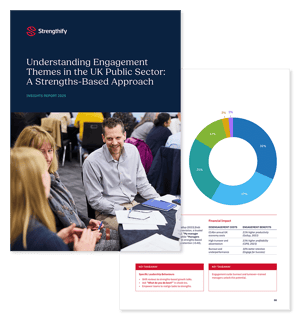
This guide draws on findings from Strengthify's Public Sector Engagement Insights Report 2025, a year-long study across 5,750 public sector respondents exploring the themes, drivers and conditions that shape employee engagement in the UK public sector.